

A Dallas accounting firm signs a new client with employees in Germany. A Fort Worth clinic rolls out a cloud scheduling platform. A Plano law office starts using a document portal hosted across multiple regions. None of those decisions sound exotic. All of them can trigger data residency requirements.
That's why this topic matters to small and mid-sized businesses now. Data location used to feel like an IT footnote. It isn't anymore. It's a business decision tied to contracts, compliance, vendor risk, and client trust. If a company in DFW handles sensitive information for customers, patients, employees, or partners in more than one jurisdiction, somebody needs to know where that data is stored, where it's replicated, and which laws apply when it moves.
Most owners don't need a lecture on international law. They need a practical way to avoid bad contracts, sloppy cloud setups, and expensive assumptions. That's the core issue. The rules are complicated, but the first steps are manageable when a business treats data location as an operational discipline instead of a legal afterthought.
Table of Contents
- Your Data Now Has a Passport What That Means for Your Business
- Residency Sovereignty and Localization Explained
- Mapping the Global Minefield Major Rules You Must Know
- Critical Misconceptions That Put DFW Businesses at Risk
- How to Build a Compliant Data Handling Strategy
- Your Data Residency Checklist and How Technovation Can Help
Your Data Now Has a Passport What That Means for Your Business
A growing business in DFW can run into data residency trouble without doing anything reckless. The problem often starts with a normal decision. A team picks a new cloud app, opens a second office, hires remote staff, or lands a customer in another country. The system goes live, data starts moving, backups replicate automatically, and nobody checks where the copies land.

That's the moment when “where the server is” turns into a compliance question. A company may operate in Texas, but customer records, support logs, analytics exports, archived files, and disaster recovery copies may sit elsewhere. If the business handles regulated or contract-sensitive data, that matters.
The scale of this issue isn't small. Nearly three-quarters of organizations globally are held to data residency requirements. A 2024 survey found 38% must process data within their operating region, and another 35% must keep it within the same country, meaning 73% of businesses face these geographic data rules, according to a 2024 data residency survey summary.
Three business situations that trigger trouble
- New overseas clients: A Dallas firm serving European customers may need to pay attention to where personal data is processed and transferred.
- Default cloud deployments: Many systems spin up in a default region unless someone changes the setting.
- Vendor sprawl: One app may be compliant on paper while its logging, support, or backup paths send data elsewhere.
Practical rule: If a business can't name the region where its primary data, backups, and logs live, it doesn't have control of its compliance position.
Small businesses sometimes assume data residency requirements only hit global enterprises with giant legal departments. That's backwards. Large enterprises usually have staff dedicated to this. Smaller firms often have one office manager, one IT contact, and a stack of vendor agreements nobody has reviewed closely. That makes the risk more manageable to fix, but easier to miss.
For a North Texas business, the smart move isn't panic. It's inventory. Find the data, map the flow, check the contracts, and correct the architecture before a client, auditor, or regulator asks questions the business can't answer.
Residency Sovereignty and Localization Explained
The terminology confuses people because vendors, consultants, and legal documents often blur the words together. That confusion causes bad decisions. A business owner reads “regional hosting,” assumes everything is compliant, and later learns the vendor still replicates metadata or backups outside the approved boundary.
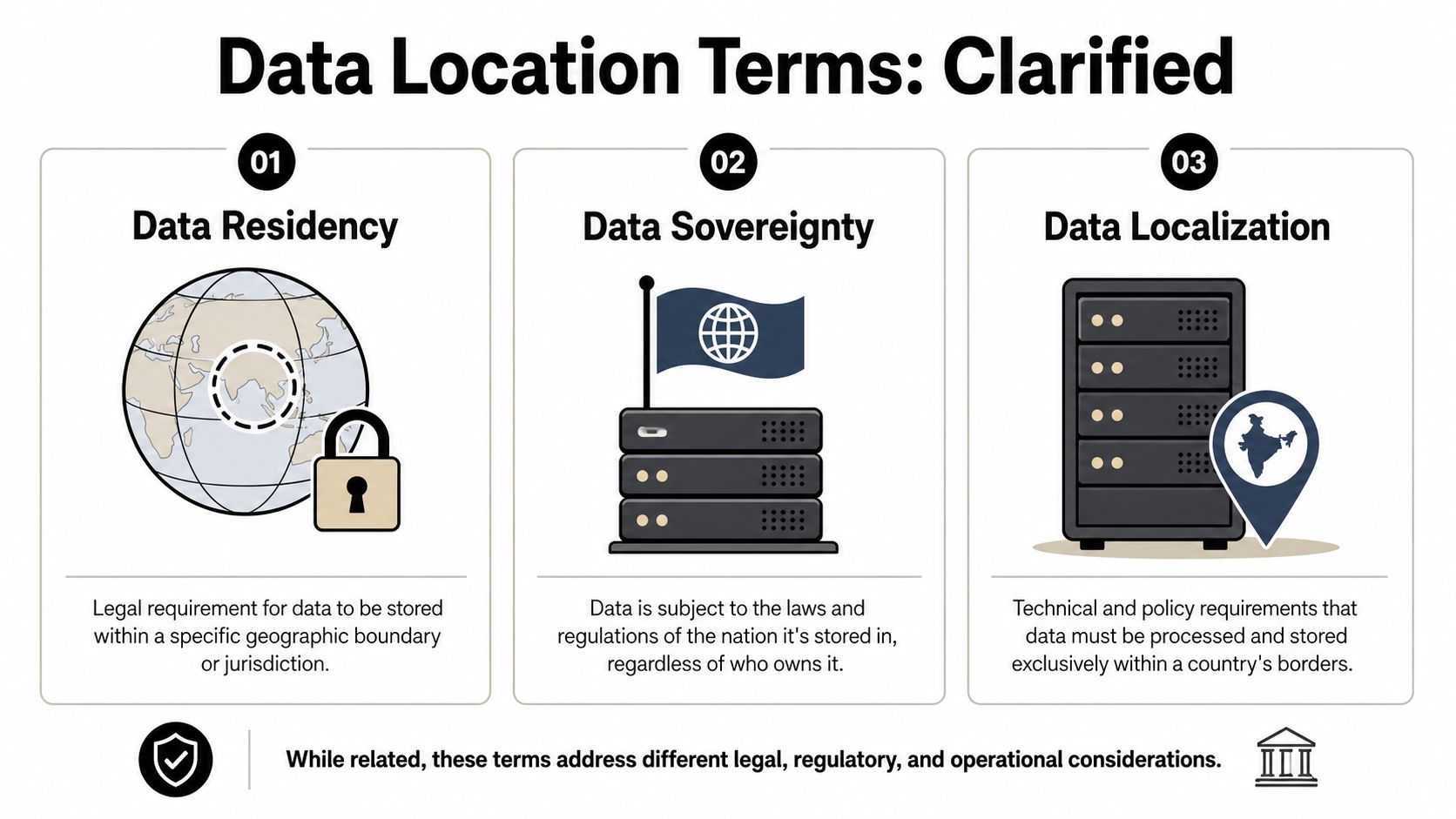
Three terms that sound similar but aren't
Think of business records as valuables stored in secure vaults.
Data residency means the business chooses the geographic place where data is stored. That might be a country, a state, or a region. The focus is location.
Data sovereignty means the data is subject to the laws of the jurisdiction where it sits. The focus is legal authority. A file stored in one country may be governed by that country's rules even if the business that owns it is based in Texas.
Data localization is the stricter version. It requires certain data to stay inside a country's borders, sometimes for storage and processing both. The focus is confinement.
These aren't academic distinctions. They change what a company can buy, how it configures systems, and what it can promise clients in contracts.
A vendor can satisfy residency preferences without satisfying localization rules. That gap is where many compliance mistakes start.
Data Location Concepts Compared
| Concept | What It Means | Business Analogy |
|---|---|---|
| Data Residency | Data must be stored within a defined geographic area | Keeping company files in a storage facility located in a specific metro area |
| Data Sovereignty | Data is governed by the laws of the place where it is stored | The rules of the town where the storage facility sits determine access and handling |
| Data Localization | Data must remain and often be processed inside a specific country | The files must stay in a storage facility inside one town and can't be moved elsewhere |
Why the distinction matters in practice
A contract may say data is “hosted in-region.” That sounds reassuring. It may still leave open questions about support access, mirrored databases, analytics processing, or backup retention outside that region. That's why businesses need to push past marketing language and ask operational questions.
A useful review usually includes:
- Primary storage: Where the live production data sits
- Secondary copies: Where backups, snapshots, and archives go
- Administrative access: Which support teams can reach the data and from where
- Legal exposure: Which jurisdiction's laws apply to the stored data
For SMBs, the goal isn't mastering every legal nuance. The goal is understanding enough to read vendor promises correctly. If a provider offers residency, that doesn't automatically mean strict localization. If a contract references sovereignty, that doesn't mean the business controls movement. Precision matters because regulators and clients won't grade on effort. They'll look at what the business did.
Mapping the Global Minefield Major Rules You Must Know
Small businesses don't need a law school seminar on global privacy regimes. They do need to know which rules can hit them directly and which trends should shape purchasing decisions today.
The rule that catches small businesses off guard
The most common example is the EU's GDPR. A DFW business doesn't need an office in Europe for GDPR to matter. Handling personal data tied to EU residents can be enough to bring the rule into the conversation, especially when data moves across borders.
The financial exposure gets attention for a reason. Under the EU's GDPR, violating data residency and cross-border transfer rules can trigger fines up to 4% of a company's global annual revenue. This isn't a theoretical risk. It's a specific penalty defined in Article 83 of the regulation, applied to firms of all sizes for improper cloud use or invalid data transfers, as outlined in this GDPR residency and transfer overview.
That matters for one simple reason. Many small businesses assume cloud adoption equals compliance. It doesn't. Migrating systems without checking regional controls can create problems faster than it solves them. That's why any company planning infrastructure changes should treat cloud migration services as a compliance exercise, not just a technical one.
Why global trends matter in North Texas
The broader direction is clear. Jurisdictions are getting stricter, not looser. According to a global data residency requirements analysis, between 2023 and 2026, nine jurisdictions shifted from conditional residency models to strict localization mandates for at least one category of data, while zero jurisdictions moved in the opposite direction. The same analysis states that of 62 jurisdictions with data localization provisions, 18 impose absolute localization and 44 use conditional models. It also projects the data residency services market will reach $53.56 billion in 2029 at a 16.1% compound annual growth rate.
Those figures matter less as market trivia and more as a warning about direction. Governments increasingly want more control over where sensitive data lives and how it leaves. That creates a practical burden for healthcare groups, financial firms, law offices, and any business that stores regulated personal information.
A few implications stand out:
- Cross-border transfers need scrutiny: “Hosted in the cloud” isn't a meaningful answer.
- Country-specific rules vary: Some regimes allow transfer with safeguards. Others don't.
- Regulated sectors feel pressure first: Healthcare, finance, and legal operations usually face the toughest client and compliance expectations.
Most SMB compliance failures don't start with malicious conduct. They start with unchecked defaults, vague contracts, and assumptions that someone else verified the setup.
For DFW owners, the takeaway is straightforward. If the business serves clients, patients, or partners beyond one jurisdiction, data location needs board-level attention, even if the company has ten employees and no international office.
Critical Misconceptions That Put DFW Businesses at Risk
The biggest mistakes around data residency requirements usually aren't technical. They're mental shortcuts. A business assumes a rule says one thing, a vendor handles everything, or the company is too small to draw scrutiny. Those assumptions create blind spots.

The HIPAA myth that keeps showing up
One misconception shows up constantly in healthcare conversations. A common but critical misunderstanding is that HIPAA mandates U.S.-only data storage for Protected Health Information (PHI). In reality, HIPAA does not specify geographic storage locations. It only requires appropriate technical safeguards, meaning healthcare providers can use compliant cloud infrastructure outside the U.S. if those safeguards are met, as explained in this HIPAA data residency discussion.
That nuance matters. A clinic that assumes HIPAA requires U.S.-only hosting may limit its options for no legal reason. Worse, it may focus on geography while ignoring stronger safeguards such as access controls, encryption, logging, and administrative discipline.
The cloud provider isn't carrying this alone
Another bad assumption is that the provider “takes care of compliance.” Providers can offer compliant capabilities. They do not automatically configure the customer's environment correctly, classify the customer's data, or negotiate the customer's contracts.
A better way to frame it is shared responsibility. The provider may secure the infrastructure. The business still owns the decisions about region selection, permissions, retention, vendor oversight, and use policies. That's why strong vendor management best practices matter. If contracts don't specify where data lives, how it's replicated, and what subcontractors touch it, the business is accepting risk blindly.
Other assumptions that deserve to be retired
- “Small firms won't be noticed.” Small firms are often easier to audit, easier to pressure contractually, and less prepared to answer data-flow questions.
- “If the app works, the setup is fine.” Functionality says nothing about lawful storage or transfer paths.
- “Backups don't count.” Backup locations can create the same residency problem as live systems.
- “A U.S. office means U.S. data handling.” Corporate headquarters doesn't determine where cloud architecture replicates data.
The dangerous question is not “Are we compliant?” The dangerous question is “Who assumed we were?”
DFW businesses in healthcare, legal, and financial services should treat these myths as operational debt. The longer they sit unchallenged, the more expensive they become to unwind during an audit, contract review, breach investigation, or client security questionnaire.
How to Build a Compliant Data Handling Strategy
Good compliance strategy is boring in the best possible way. It turns big legal concepts into repeatable technical and contractual controls. That's what works. Not slogans. Not checkbox policy binders. Controls.
Start with technical controls that actually matter
The first control is region pinning. Effective technical compliance requires region pinning across the entire data lifecycle, from storage and compute to backups and disaster recovery. Architectures must use location-aware routing and region-locked backups to ensure replicas stay within the approved jurisdictional boundary, preventing accidental cross-border data replication, according to this technical guide to data residency controls.
That sentence matters because many businesses only check primary storage. That's not enough. Data can leave the approved boundary through logs, snapshots, analytics pipelines, recovery environments, and support tooling.
A practical technical strategy usually includes:
- Location-aware ingestion: Send data to the right jurisdiction from the start instead of moving it later.
- Region-locked backup design: Keep recovery copies inside the same approved boundary.
- Jurisdictional key management: Store encryption keys in the same jurisdiction as the protected data where required.
- Data masking at the source: Remove personal identifiers before moving data when the business use case allows it.
- Geographic access restrictions: Limit who can view raw regulated data based on approved regions.
For healthcare teams sorting out operational controls around protected information, resources on HIPAA compliant patient data management can help frame how data handling, privacy, and workflow discipline should fit together.
Strong residency control isn't one setting. It's a chain of settings that all have to agree with one another.
Then lock it down in contracts and process
Technology alone won't save a weak vendor agreement. If the contract allows broad subcontractor use, silent replication, or undefined support access, the business may still be exposed.
A sound contract review should cover:
Permitted storage locations
The agreement should name where data can be stored and processed.Backup and disaster recovery boundaries
If the contract is silent here, the business should assume the architecture may not stay contained.Support and telemetry handling
Metadata, diagnostics, and troubleshooting artifacts can create hidden cross-border movement.Data classification alignment
A business can't protect what it hasn't categorized. A formal data classification policy gives teams a basis for deciding which data requires tighter location control and which data can move under approved safeguards.
The best compliance posture comes from combining architecture, contract language, and internal process. If one of those pieces is missing, the strategy is fragile. If all three line up, data residency requirements become manageable. Not easy, but manageable. That's the standard small businesses should aim for.
Your Data Residency Checklist and How Technovation Can Help
Knowing the terms is useful. Running a checklist is what keeps a business out of trouble.
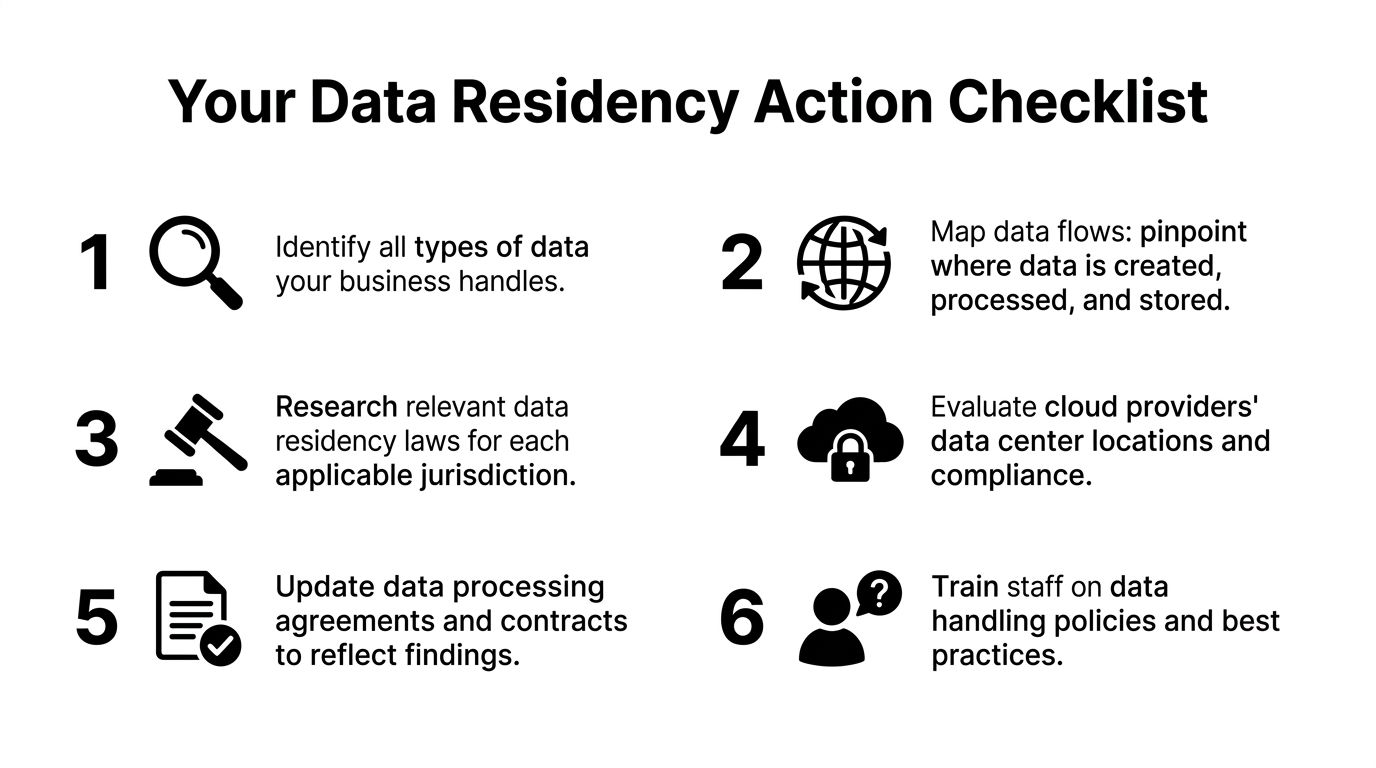
A working checklist for busy businesses
This doesn't need to become a six-month internal project. It does need ownership.
- Identify sensitive data first: List the categories that matter most, such as client records, PHI, financial data, employee data, legal files, and regulated communications.
- Map the flow: Document where each category is created, processed, stored, backed up, archived, and accessed.
- Review cloud region settings: Check live workloads, recovery environments, exports, and logs. Don't stop at production storage.
- Read vendor agreements carefully: Look for storage location language, subcontractor terms, support access, and transfer provisions.
- Update internal policies: Security rules should match actual system behavior, not wishful thinking.
- Train the people touching the data: Administrative staff, operations teams, and managers all make decisions that affect residency compliance.
A checklist also needs escalation rules. If the business can't answer where regulated data is backed up, who can access it from other regions, or what the vendor promises contractually, that issue should move to leadership immediately.
Why local execution beats vague good intentions
Most SMBs don't fail because they don't care. They fail because nobody owns the cross-section between compliance, cloud architecture, procurement, and daily operations. That's where outside guidance earns its value.
A local managed IT and compliance partner can turn this from an abstract risk into a controlled process by helping a business:
- Audit data locations across systems
- Validate cloud region and backup configurations
- Review vendor obligations and risk language
- Align policies with actual infrastructure
- Build incident response steps around regulated data handling
- Document decisions for client questionnaires and audits
That documentation piece matters. When a client asks how the business controls data residency, the answer can't be “the provider handles that.” It needs to be a clear explanation backed by settings, policy, and contract terms. Tightening the data protection clause in vendor and customer agreements is part of that discipline.
Compliance gets easier when one team owns the map, the contracts, and the configuration. Without that, businesses end up guessing.
For DFW businesses, local support has a practical advantage. It's easier to solve these issues when the advisor understands the regional business environment, the regulated industries common to North Texas, and the fact that most SMBs need pragmatic fixes, not theory. A law firm doesn't need a global strategy deck. It needs its document systems reviewed. A clinic needs its PHI workflows checked. A finance office needs backup boundaries confirmed.
That's why the smartest move is usually not to buy another platform first. It's to verify the business already understands where its data lives and whether that setup matches its obligations.
Technovation LLC helps North Texas businesses turn data residency requirements into a manageable operating process instead of a recurring headache. For healthcare clinics, law firms, accounting teams, and other regulated organizations, Technovation LLC can help assess data flows, review vendor risk, validate cloud configurations, and close the gaps that usually stay hidden until an audit or client questionnaire forces the issue. A practical IT health check now is far cheaper than cleaning up a preventable compliance problem later.