Most companies don’t ask the right first question about oil and gas IT. They ask which platform to buy, which dashboard to deploy, or which security product to add. The better question is simpler. Can the business scale a digital project from a promising pilot into a dependable operating model without creating new risk?
That question matters far beyond the field. In Dallas-Fort Worth, construction firms, engineering groups, legal practices, financial services companies, and other regulated businesses often work inside the broader energy ecosystem, directly or indirectly. Their systems exchange project documents, financial records, compliance data, vendor communications, and operational information with energy clients and partners. If those systems are weak, slow, or inconsistent, the business problem doesn’t stay confined to IT.
The market reflects that pressure. The global oil and gas consulting service market was valued at approximately USD 15 billion in 2023 and is projected to reach USD 28 billion by 2032, and the US is projected to have 22,706 oil, gas, and mining consulting businesses in 2026, according to oil and gas consulting service market projections. Businesses don’t invest in that level of specialized support unless the underlying problems are operational, regulatory, and expensive to ignore.
Generic IT support isn’t built for this environment. Oil and gas IT consulting sits where uptime, cybersecurity, governance, field operations, and executive decision-making collide. For DFW businesses that support or serve this sector, understanding that reality is no longer optional. It’s part of protecting margin, maintaining trust, and staying competitive in a high-stakes regional economy.
Table of Contents
- Introduction Why Every DFW Business Needs to Understand Energy Sector IT
- What Is Oil and Gas IT Consulting Really
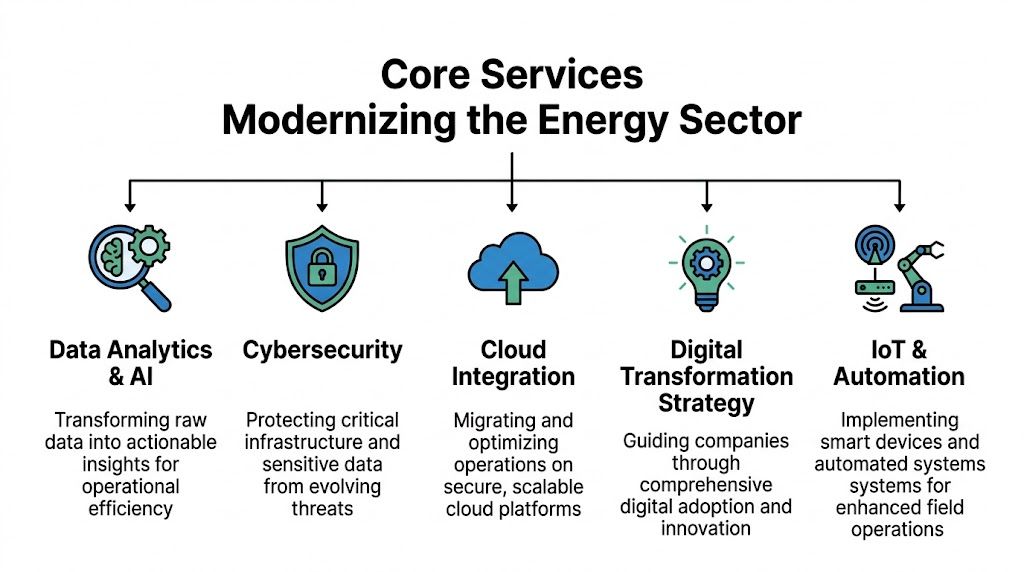
- The Core Services Modernizing the Energy Sector
- Navigating High-Stakes Risks and Regulations
- Why Most Digital Projects Stall and How to Succeed
- Choosing Your IT Partner in Dallas-Fort Worth
- Conclusion Building Your Resilient and Competitive Operation
Introduction Why Every DFW Business Needs to Understand Energy Sector IT
The modern energy sector runs on more than production assets. It runs on data movement, secure communications, operational visibility, and decisions made fast enough to matter. When a contractor updates a project schedule, a finance team processes energy-related transactions, or a law firm handles sensitive regulatory records, those actions often sit inside the same chain of operational risk.
That’s why oil and gas IT consulting matters even to companies that don’t drill a well, manage a pipeline, or operate heavy equipment themselves. A DFW business can still be pulled into energy-sector expectations around uptime, documentation, cybersecurity, and audit readiness by serving that market.
The local business impact
A regional construction company might need secure remote access for field teams. An engineering firm may need better control over versioning and data transfer between office and project sites. A financial services provider may need tighter access controls around sensitive client records linked to regulated operations. The technical requirement looks different in each case, but the business issue is the same. Systems have to support trust under pressure.
Businesses in the energy ecosystem don’t get judged only on service quality. They get judged on whether their systems hold up when partners, regulators, or clients start asking hard questions.
Why standard IT thinking falls short
Traditional office IT focuses on devices, help desk tickets, email, and line-of-business software. Those are still important. But businesses tied to energy clients often need something broader: stronger governance, clearer ownership of data, better integration between systems, and security controls that reflect actual-world consequences of failure.
The gap usually appears when leadership assumes that “working IT” is the same as “fit-for-purpose IT.” It isn’t. A system can function day to day and still be poorly prepared for compliance reviews, remote operations, vendor collaboration, or incident response.
A company doesn’t need to become an energy producer to inherit energy-sector risk. In DFW, proximity alone can make that risk relevant.
What Is Oil and Gas IT Consulting Really
Oil and gas IT consulting is often described as a bundle of services. That description is too shallow. A better way to think about it is this: it acts like the central nervous system for complex operations, connecting what the business needs to know with what the operation is doing.

In a standard office setting, IT mostly supports information work. In energy environments, consulting has to bridge information technology and operational technology. That means the digital side of the business has to interact safely with systems that influence physical assets, production processes, field conditions, and remote infrastructure.
More than office IT
Oil and gas operations generate information from many different sources. That can include sensor data, control systems, drilling tools, and large technical datasets from exploration and production environments. The hard part isn’t just collecting it. The hard part is turning it into something accurate enough to guide operations.
That’s where data architecture becomes central. Oil and gas environments rely heavily on ETL or ELT pipelines to move raw information into usable business intelligence. The transformation layer carries unusual weight because it defines how raw operational data becomes reports, alerts, and decision support. According to this explanation of data integration consulting in oil and gas, these environments also deal with disparate sources, remote field constraints, legacy system complexity, and datasets that can span whole petabytes.
Where the real risk sits
Many business owners assume integration is mostly a convenience issue. In this setting, it’s not. If the wrong data is transformed poorly, delayed, duplicated, or shared without context, the result can be flawed maintenance planning, poor operational visibility, and decisions based on conflicting records.
A useful distinction is below:
| Focus area | Traditional business IT | Oil and gas IT consulting |
|---|---|---|
| Primary objective | Keep users productive | Keep operations informed and controlled |
| Typical systems | Email, endpoints, business apps | Data pipelines, field connectivity, industrial data flows |
| Risk of failure | Lost time and service disruption | Operational disruption, compliance exposure, security gaps |
| Consulting value | Support and maintenance | Integration, governance, security, scaling |
The job isn’t to “add technology.” The job is to make digital systems reliable enough to support physical operations without creating new failure points.
That’s why oil and gas IT consulting shouldn’t be treated as a niche version of managed IT. It’s a discipline built around operational consequence.
The Core Services Modernizing the Energy Sector
When businesses hear “oil and gas IT consulting,” they often expect a list of technical tasks. The better view is to look at the operational outcomes these services support. The strongest consulting work doesn’t start with products. It starts with friction inside the business.
The demand for those outcomes is growing quickly. The oil and gas analytics market is forecasted to grow from USD 12.28 billion in 2025 to USD 71.93 billion by 2034, according to oil and gas analytics market projections. That growth reflects a simple reality. Companies need help turning large, messy, operational data flows into usable decisions.
Where consulting creates operational value
Some services solve obvious problems. Others prevent expensive ones that leadership may not see until late.
OT and IT integration
When office systems and operational systems live in separate silos, teams make decisions from partial information. Good integration work creates cleaner handoffs between business applications, field reporting, and operational records. Weak integration creates rework, version confusion, and blind spots.Industrial cybersecurity
Security in this environment isn’t just about protecting laptops and email. It has to account for operational assets, remote connectivity, access by vendors, and the reality that downtime can affect physical operations. A secure design usually includes tighter segmentation, stronger identity controls, continuous monitoring, and clearer incident response responsibilities.Cloud architecture for remote operations
Cloud adoption can improve access, resilience, and collaboration, but only if the design reflects field conditions and data sensitivity. Remote sites often deal with bandwidth limits, sync delays, and inconsistent connectivity. Moving everything at once usually creates frustration. Targeted migration tends to work better.Data analytics and predictive operations
Analytics matters when it helps teams act sooner. In practice, that often means cleaner maintenance signals, better production visibility, and faster identification of anomalies. If the underlying data is inconsistent, analytics becomes noise dressed up as insight.
What strong delivery looks like
The same service can succeed or fail depending on how it’s implemented. A flashy dashboard launched on bad source data is still bad data. A security program that ignores field workflows often gets bypassed. A cloud project that doesn’t account for remote operations quickly turns into a user complaint backlog.
A more practical standard looks like this:
Start with a narrow operational problem
Pick a real constraint such as delayed field reporting, inconsistent asset data, or unsecured remote access.Stabilize the data path
Before adding automation or analytics, make sure collection, transformation, ownership, and access rules are clear.Build controls into the workflow
Security and compliance work best when they support the way teams already operate, rather than forcing constant workarounds.Measure whether teams use the outcome
If supervisors, finance staff, operations leads, or compliance owners don’t trust the output, the project isn’t modernizing anything.
Strong consulting work reduces operational guesswork. Weak consulting work adds a new layer of complexity and calls it innovation.
For businesses in the DFW energy orbit, the takeaway is straightforward. The right service isn’t the one with the most features. It’s the one that removes friction without creating a second problem.
Navigating High-Stakes Risks and Regulations
In most industries, a technology failure is expensive. In energy and regulated environments, it can also trigger operational disruption, reporting failures, contract problems, and legal exposure. That’s why governance matters as much as infrastructure.
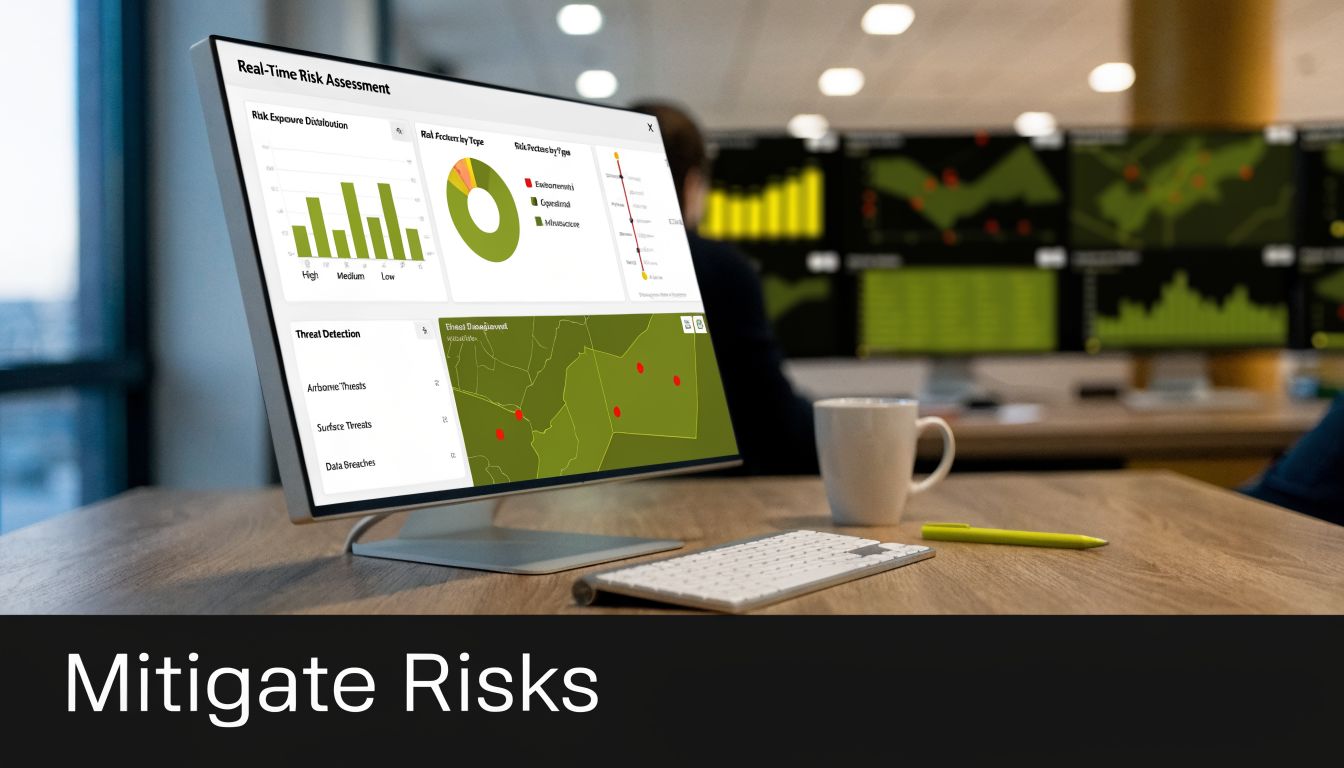
A mature governance model doesn’t appear because a company bought the right software. It has to define ownership, standards, policies, and auditing procedures across the data lifecycle. According to this discussion of data governance for oil and gas, a mature framework requires defined roles, standards, and auditing procedures, and 70% of digital transformation success depends on change management investment. That point gets overlooked constantly.
Why governance matters more than tools
Most companies don’t struggle because they lack one more system. They struggle because no one has clearly decided:
- Who owns critical data
- Which version of a record is authoritative
- Who can access what and under which conditions
- How exceptions are documented
- What happens when teams disagree
Those are governance questions, not product questions.
In oil and gas IT consulting, this distinction matters because operations often involve multiple departments, external partners, and legacy environments that were never designed to share information cleanly. If production, finance, compliance, and operations each maintain their own unofficial truth, leadership can’t make reliable decisions.
What regulated businesses should expect
Compliance isn’t a one-time project. It’s a repeatable operating discipline. That means businesses need documentation, logging, access control, review cycles, and response plans that hold up under scrutiny.
A practical governance checklist for regulated businesses includes:
Defined responsibilities
Every sensitive system and data domain needs a named owner, not a vague shared responsibility.Access discipline
Permissions should match job roles and be reviewed regularly, especially for remote users, third-party vendors, and temporary staff.Audit readiness
The business should be able to explain how data is handled, where it moves, and how exceptions are tracked.Security alignment
Security controls should support the broader compliance posture, not operate as a disconnected IT initiative. A useful starting point is a broader look at data security and compliance planning for regulated businesses.
Companies usually don’t fail compliance because they care too little. They fail because responsibilities are fragmented and the process depends on memory instead of system design.
That’s the hard truth. In high-stakes environments, governance is not administrative overhead. It’s part of the license to operate.
Why Most Digital Projects Stall and How to Succeed
The biggest problem in oil and gas IT consulting isn’t a lack of ideas. It’s the failure to scale them. Many businesses can launch a pilot. Far fewer can turn it into a stable, repeatable capability that survives budget reviews, staffing changes, and day-to-day operating pressure.

That gap is well documented. According to McKinsey, 70 percent of oil and gas companies have not moved their digital technologies beyond the pilot phase, as noted in McKinsey’s analysis of technology transformation in oil and gas. That statistic matters because it confirms what many operators and support firms already feel. Pilot success doesn’t automatically become business success.
Why pilots get stuck
Most stalled projects don’t fail because the original concept was bad. They stall because the conditions required for scale were never built.
Common patterns include:
| Reason a pilot stalls | What it looks like in practice |
|---|---|
| Fragmented legacy systems | Teams need manual workarounds to move data between old and new systems |
| Unclear ownership | No one owns rollout, support, training, or long-term funding |
| Weak data quality | Users stop trusting outputs because source data is inconsistent |
| Poor change management | Staff understand the pilot but not the new process expected at scale |
| Budget mismatch | Leadership funds experimentation but hesitates on full operational rollout |
A lot of consulting content treats scaling as if it’s mainly technical. It isn’t. It’s operational and organizational. The business has to decide what gets standardized, who changes their process, what gets retired, and how success will be managed after the launch team leaves.
A pilot proves something can work. It doesn’t prove the business is ready to operate it every day.
A practical roadmap for scaling
Companies in the DFW energy ecosystem usually do better with a phased model than a broad “digital transformation” program. The goal is steady adoption, not a dramatic launch.
A pragmatic roadmap looks different from a flashy one:
Choose one operational bottleneck
Focus on a process that already frustrates multiple teams. That creates internal pull instead of forced adoption.Fix data quality early
If the underlying records are unreliable, adding automation only spreads confusion faster.Design for support from day one
A rollout plan should include ownership, escalation, user training, and governance before the pilot expands.Prove business usefulness, not technical novelty
The most important question isn’t whether the system is impressive. It’s whether supervisors, managers, and compliance stakeholders rely on it without workarounds.Scale by workflow, not by hype
Expand into adjacent use cases only after the first one becomes routine and trusted.
What doesn’t work is forcing an enterprise-wide launch on top of unresolved data issues and unclear accountability. That approach usually creates resistance, not momentum.
Businesses don’t need bigger pilots. They need smaller promises, better operating discipline, and a scaling plan grounded in how people work.
Choosing Your IT Partner in Dallas-Fort Worth
Selecting an advisor for oil and gas IT consulting isn’t about finding a firm that can say the right technical words. It’s about finding one that understands operational consequence, regulated environments, and the realities of mid-sized businesses that can’t afford endless redesigns.
A good partner should be able to talk to leadership, operations, compliance owners, and technical staff without losing the thread. That matters because effective OT cybersecurity requires collaboration between process engineers, vendors, and IT staff, as described in this discussion of OT cybersecurity collaboration. Businesses that treat it as a pure IT issue usually leave gaps open.
The questions that actually matter
Instead of asking for a generic service menu, decision-makers should ask questions like these:
Can the firm bridge business risk and technical design
If the conversation stays trapped in hardware, software, and alerts, it’s too narrow.Do they understand regulated operating environments
A capable partner should be comfortable discussing policy, documentation, access reviews, retention concerns, and incident response in business terms.Can they support both office IT and operational realities
Even if they’re not directly managing field assets, they should understand the consequences of remote access, vendor connectivity, and shared data workflows.Do they have a practical selection framework
Businesses that want a stronger baseline can compare providers against a structured managed service provider selection checklist.
Red flags worth taking seriously
Some warning signs appear early if leadership knows what to watch for.
Everything sounds easy
Serious work in this space involves trade-offs. A partner who skips over complexity may also skip over risk.They lead with tools, not outcomes
If the first answer to every challenge is a new platform, the firm may be selling motion instead of solving problems.They ignore internal adoption
A project plan that doesn’t address training, workflow changes, or ownership usually creates dependency without stability.They don’t ask about partners and vendors
In regulated environments, third-party access and shared responsibilities matter. A firm that never asks probably isn’t designing for the actual environment.
The right IT partner doesn’t just reduce ticket volume. They help leadership make better risk decisions with clearer visibility into what the business can support.
For DFW businesses, local context adds another advantage. Regional providers often understand the pace, expectations, and interconnected nature of North Texas industries better than firms that treat every regulated business the same.
Conclusion Building Your Resilient and Competitive Operation
Oil and gas IT consulting isn’t valuable because it sounds specialized. It’s valuable because standard IT thinking breaks down when the business depends on secure data flows, operational reliability, audit readiness, and disciplined scaling.
For DFW companies connected to the energy sector, the stakes are practical. Systems have to support remote work, partner collaboration, security controls, compliance expectations, and decision-making under pressure. That applies to operators, but it also applies to the construction firms, engineers, legal teams, financial professionals, and regulated service providers around them.
The biggest mistake is assuming digital progress comes from doing more technology at once. It usually doesn’t. Stronger outcomes come from cleaner governance, better integration, realistic rollout plans, and a clear view of how operations actually run. That’s why so many flashy projects stall while quieter, more disciplined efforts produce lasting value.
There’s also an opportunity here. Businesses that treat IT as part of operational resilience tend to make better decisions about access, data ownership, security, and scale. They’re easier to work with, easier to trust, and better prepared when a client, regulator, or partner asks for proof instead of promises.
A resilient operation isn’t built by reacting to the next incident. It’s built by designing systems that are easier to manage, easier to secure, and easier to scale. For businesses in the DFW market, that’s not a technical side project. It’s a business decision with direct impact on growth, reputation, and risk.
If a business in North Texas needs a clearer picture of where its systems stand, Technovation LLC offers practical help for regulated and security-conscious organizations. Their team brings 25 years of experience, proactive 24/7 monitoring, cybersecurity and compliance support, and strategic IT guidance specific to real operating conditions. A complimentary security audit or IT health check can help identify vulnerabilities, governance gaps, and realistic next steps without turning the process into a massive overhaul.