
A growing business often thinks its security perimeter sits at the office firewall or inside a cloud app login page. In practice, the first real point of failure is usually much closer to the employee. It's the laptop at a kitchen table, the phone used to approve a sign-in, the desktop in accounting, or the server that hasn't restarted in too long.
That's why endpoint protection has become a business operations issue, not just an IT purchase. One industry estimate puts the global endpoint security market at USD 16.22 billion in 2022 and projects USD 28.80 billion by 2030, implying a 7.4% CAGR from 2023 to 2030, with BYOD adoption called out as a key growth driver in this endpoint security market overview. For a busy SMB owner, that trend matters for one reason: the number of devices touching business data keeps growing, and every one of them can become an entry point.
Table of Contents
- Why Endpoints Decide Your Security Posture
- What an Endpoint Protection Service Really Is
- Core Capabilities That Make Protection Work
- How MSP Delivered Endpoint Protection Works Day to Day
- Benefits for SMBs and Regulated Industries
- How to Choose Pricing Models and Measure ROI
- Your Implementation and Compliance Readiness Checklist
Why Endpoints Decide Your Security Posture
A payroll clerk logs in from home before 8 a.m., opens a shared spreadsheet, approves a sign-in on a phone, and answers email between tasks. Everything looks normal. If that laptop or phone has been compromised, an attacker is not starting from the outside. They are stepping into an active workflow that already has permission to reach business systems.
That is why endpoints do so much to shape a company's security posture. The firewall still matters, and cloud security still matters, but the device in a user's hands often decides whether those controls hold or fail under pressure.

The attack surface moved outward
For many SMBs, work no longer happens from a small set of office PCs that all follow the same routine. It happens across laptops, phones, remote sessions, tablets, and personal devices that touch company email or files for a few minutes at a time. Security becomes harder to manage when those devices do not receive the same updates, policies, and oversight.
The problem is not only infection. It is uneven control.
One device is patched this week. Another has not checked in for days. One user signs in from a managed laptop. Another uses a personal phone to approve access requests. Those gaps create inconsistency, and inconsistency is what turns a good security plan on paper into weak coverage in practice.
That is also why endpoint security and endpoint operations overlap. Businesses that want fewer blind spots usually need a clear device inventory, enforced policies, and proof that each device is covered. For teams sorting that out, endpoint management guidance for device inventory and policy control can help connect the operational side with the security side.
Endpoints are where security becomes measurable. Coverage rates, policy compliance, alert response time, and device isolation speed all start there.
Why this matters to owners, not just IT staff
Business owners rarely need a lesson in detection engines or scanning methods. They need to know whether a suspicious device can be found quickly, isolated quickly, and returned to service without dragging down the rest of the business.
A simple analogy helps. A smoke detector is useful, but a building is safer when someone verifies every floor has coverage, tests the alarms, and knows who responds when one goes off. Endpoint protection works the same way. The tool matters, but the operating discipline around the tool is what produces reliable results.
That is where many SMBs get stuck. Buying software can check a box. Running endpoint protection as a service creates outcomes you can track: which devices are protected, which ones are missing controls, how long alerts sit before review, and how fast a risky device can be contained.
For regulated businesses, that difference matters even more. Auditors and insurers usually care less about product names than about evidence. They want to see consistent coverage, documented policies, response actions, and reports that show the program is active instead of assumed.
What an Endpoint Protection Service Really Is
An endpoint protection service is the day-to-day operation that keeps device security working across the whole business. It includes the security software on laptops, desktops, and servers, but it also includes setup, policy control, alert review, response actions, reporting, and proof that coverage stays consistent over time.
That distinction matters because many SMBs buy a capable tool and assume protection is in place everywhere. In practice, gaps appear fast. A new laptop is deployed without the right policy. An alert waits in a queue because no one owns it. A device falls out of reporting after an update and nobody notices until an audit or an incident forces the issue.
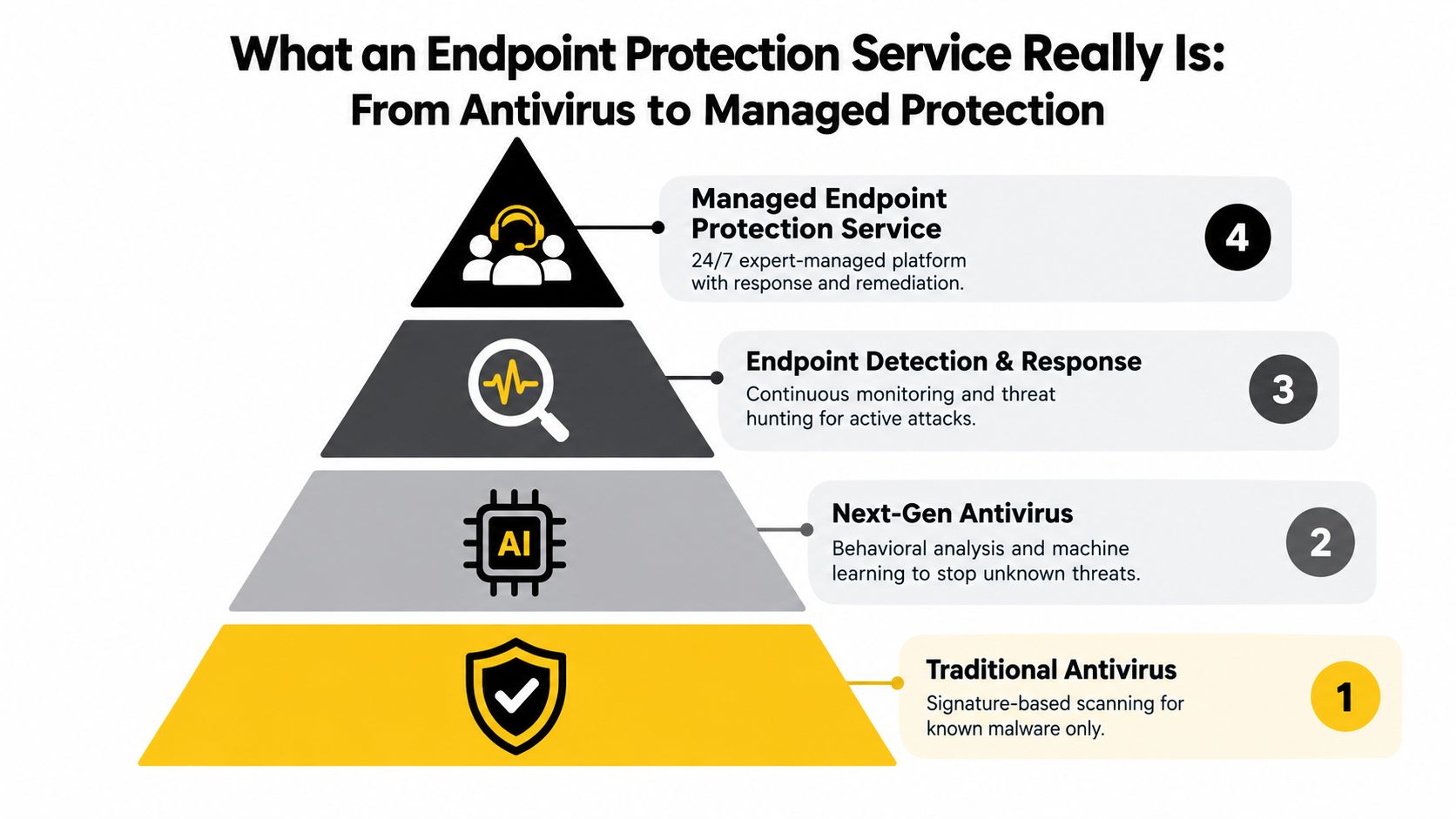
A building security comparison helps here. The software is the lock, camera, and alarm. The service is the guard routine that checks every entrance, reviews the footage, responds to a problem, and keeps records to show the system is being used. Business owners usually need that second part more than another long feature list.
Service turns security tools into operating results
Traditional antivirus focused mainly on known bad files. Modern endpoint protection covers a wider set of problems, including suspicious behavior, misuse of legitimate system tools, risky scripts, and signs that an attacker is trying to move from one device to another.
What makes it a service is the operational layer around those controls:
- Coverage management verifies devices are enrolled, healthy, and following policy.
- Alert triage sorts routine noise from activity that needs action.
- Containment isolates a device or stops a process before the issue spreads.
- Investigation support records what happened and when.
- Reporting gives management and auditors evidence, not assumptions.
This is why endpoint protection should be judged by outcomes as much as features. Useful questions are simple. How many endpoints are covered? How quickly can a risky device be contained? How consistently are policies applied across offices, remote staff, and servers? Those measurements tell you whether protection exists in daily operations, not just in a purchase record.
Why buyers often confuse product and service
The confusion is understandable. Vendor marketing often describes what the tool can detect, but not who runs the workflow after detection. Independent ATT&CK-based evaluations examine prevention, detection, and investigation against many attack techniques, which helps show that modern endpoint defense is broader than antivirus alone. Even so, strong test results do not guarantee that a small business has someone reviewing alerts, tuning policies, documenting actions, and closing gaps across every device.
A service approach asks practical ownership questions:
- Who checks alerts every day?
- Who decides whether the activity is harmless or risky?
- Who can isolate the device right away?
- Who keeps records for management, insurance, or compliance review?
Practical rule: If nobody owns those daily tasks, the company has bought software. It has not yet built a reliable protection service.
For SMBs, that is the shift. Endpoint protection is no longer just an installed product on each device. It is an operating service that produces measurable results, steady coverage, and audit-ready evidence. MSP delivery often closes that gap by turning scattered endpoint tools into a repeatable process with defined response steps and documented outcomes.
Core Capabilities That Make Protection Work
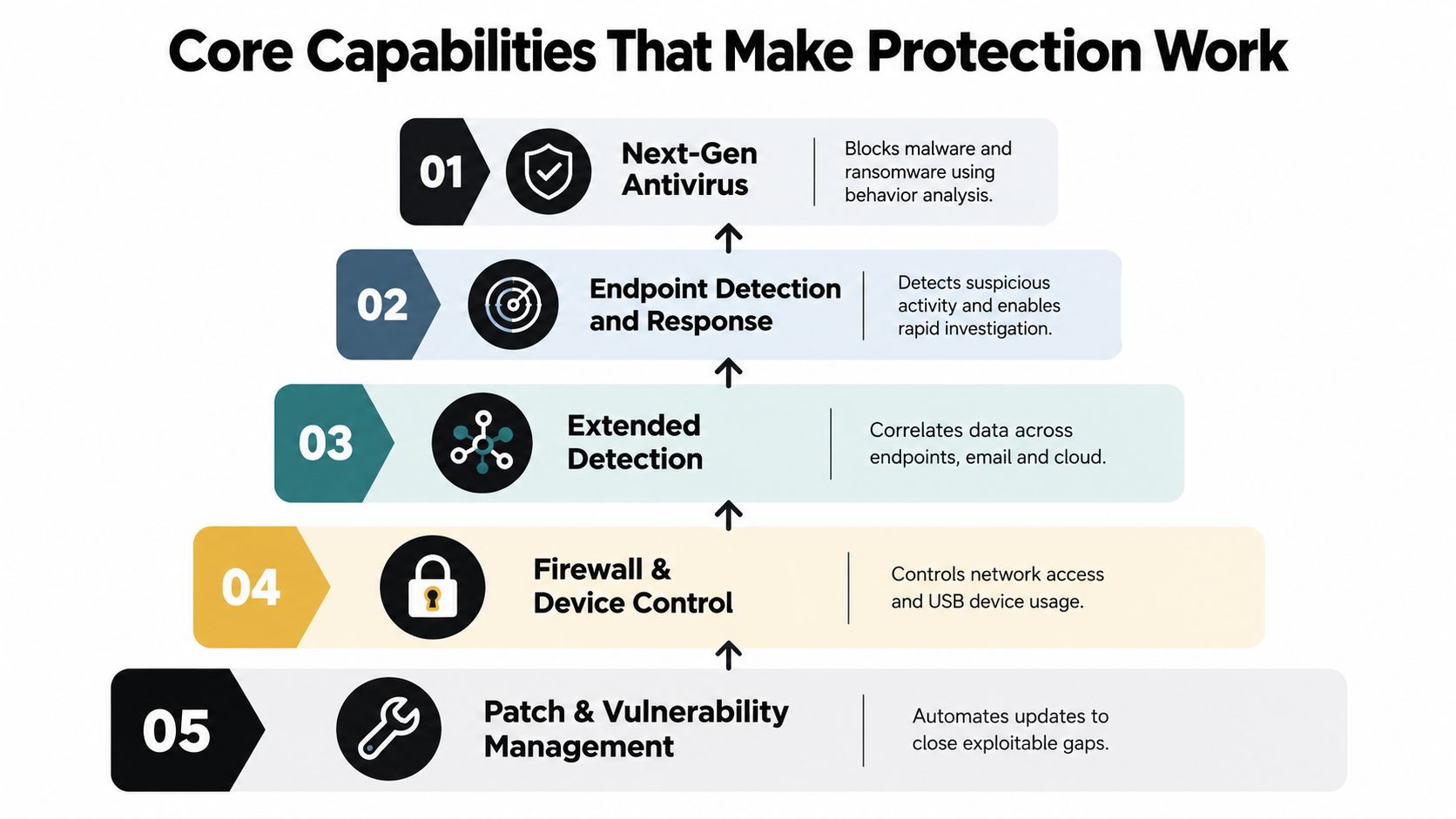
An endpoint protection service works best when its parts support one another in daily operations. A business does not get reliable coverage from a single feature. It gets results from a set of controls that prevent common problems, expose risky behavior, contain active threats, and document what happened for follow-up and audits.
Prevention reduces the daily incident load
Next-generation antivirus still matters because it stops a large share of routine threats before they become support tickets or investigations. That includes fake invoices, malicious attachments, and untrusted downloads that a busy employee may open during a normal workday.
Its value is practical. Fewer preventable infections means less cleanup, less downtime, and less noise for whoever has to watch alerts.
Detection shows what happened and how far it spread
Some threats get past the first layer. Endpoint detection and response helps teams reconstruct events on the device, including which process started, what files changed, and what connections followed. That context matters because a suspicious alert is only useful if someone can tell whether it was harmless, contained, or part of a larger compromise.
Extended detection and response broadens that view by correlating endpoint activity with signals from email, identity, and cloud systems. An attacker rarely stays in one lane. A malicious email can lead to a stolen login, then a suspicious device action. Businesses that want to reduce that entry path should also review best practices for secure email campaigns, since email still plays a major role in endpoint compromise.
Control limits prevent small shortcuts from becoming large problems
A well-run service also sets boundaries on what devices are allowed to do. These controls are less flashy than detection, but they often prevent the mistakes that create repeat incidents.
- Device control restricts risky use of USB storage and other removable media.
- Firewall and access policy enforcement blocks unnecessary connections between devices and outside systems.
- Application oversight reduces unapproved software on business machines.
A simple analogy helps here. Office doors, file cabinets, and visitor badges do different jobs, but together they reduce avoidable risk. Endpoint controls work the same way. They limit casual misuse, make suspicious behavior easier to spot, and keep coverage consistent across laptops, desktops, and servers.
Patching turns known weaknesses into closed doors
Patch and vulnerability management handles one of the most measurable parts of endpoint security. If known weaknesses stay open on devices, prevention and detection teams spend time dealing with problems that should have been removed earlier.
This is also where service quality becomes visible. It is one thing to say patching is enabled. It is another to show which devices missed updates, how long they stayed exposed, and whether remote or rarely connected systems drifted out of policy. Teams that review cybersecurity monitoring tools and operational practices usually find that endpoint data becomes much more useful when monitoring, patch status, and response records are tied together.
Recovery matters because operations have to resume
Anti-ransomware protection should include a rollback or recovery method, not just a detection alert. One documented rollback approach can back up files before encryption begins and restore original files after the attack is stopped.
That capability matters for a simple reason. Owners usually ask two questions after a ransomware event: was it contained, and how quickly can work resume? A protection service should answer both with evidence. Fast containment helps limit spread. Reliable recovery helps reduce downtime. Consistent records help prove what was protected, what was affected, and what actions were taken.
That is the difference between a feature list and an operational service. The right capabilities do more than sit on a brochure. They produce measurable outcomes such as coverage consistency, containment speed, and audit-ready documentation.
How MSP Delivered Endpoint Protection Works Day to Day
Monday starts with a familiar problem. A remote employee opens a laptop that has been offline for days, a server throws a suspicious process alert, and nobody on your team has time to sort signal from noise before the workday gets busy.
That is the practical difference between owning endpoint software and running endpoint protection as a service. The tool may be installed on every device, but daily protection still depends on people following the same process every time. In many SMBs, that responsibility falls to a small IT team already covering support, onboarding, vendor issues, and projects.
What the managed model changes
An MSP-delivered service adds a repeatable operating rhythm around the endpoint tool. A good comparison is an alarm system with a trained dispatch center behind it. The sensor matters, but the outcome depends on who reviews the signal, how quickly they act, and whether every location is covered the same way.
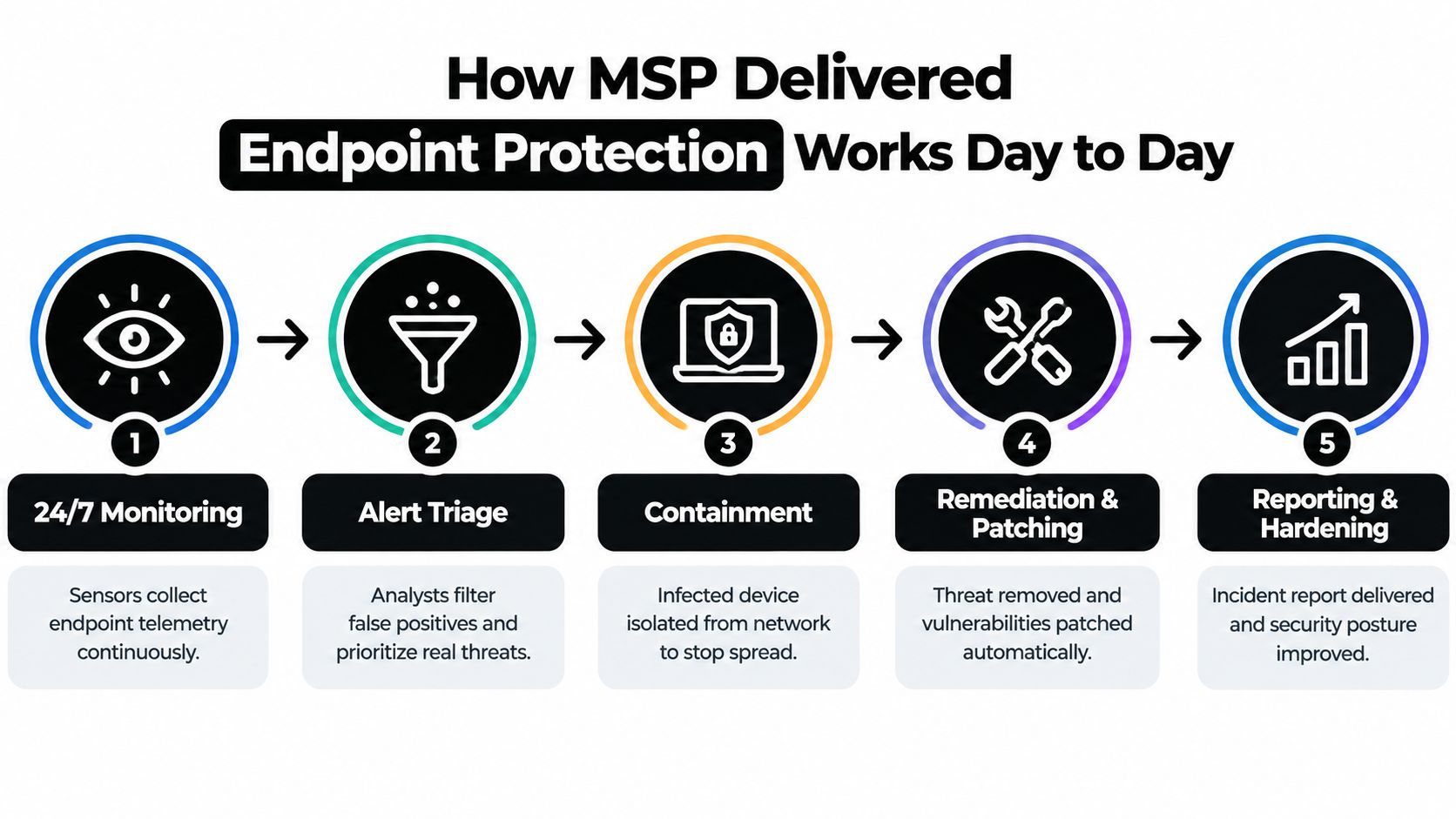
A typical day-to-day cycle looks like this:
- Monitoring runs continuously. Endpoint sensors report activity from laptops, desktops, and servers into a central queue.
- Alerts are triaged. Routine noise is filtered, suspicious behavior is reviewed, and the event is classified.
- Affected devices are contained. The priority is to stop spread while keeping enough evidence for investigation.
- Remediation is carried out. Malicious files are removed, policy gaps are corrected, and missed updates are addressed.
- Results are documented. Leadership gets a record of what happened, what changed, and what still needs follow-up.
The workflow itself is not complicated. Consistency is the hard part.
Why service metrics matter
Busy owners do not need a long feature checklist. They need to know whether the service produces reliable outcomes. Useful questions include how fast suspicious devices are isolated, how often alerts are closed correctly, how many devices are fully reporting, and how long systems stay outside policy before someone follows up.
Independent guidance often describes healthy benchmarks in operational terms. Dwell time should stay short. Containment should happen in minutes, not hours. False positives should stay low enough that teams do not start ignoring alerts.
Those measures show whether the service works under pressure. Fast containment with weak review can interrupt employees who are trying to work. Careful review with slow action can leave an active threat on the network longer than necessary. Good endpoint operations balance speed, judgment, and documentation.
Coverage is usually the real day-to-day challenge
Many companies do reasonably well on the devices they see every day. The trouble starts with the machines that drift to the edge of operations. A sales laptop that rarely returns to the office. A spare workstation used only during busy season. A server that reports inconsistently after a change.
Endpoint protection works like inventory control. If items are missing from the shelf count, the report may look tidy while the situation is not. The same thing happens with security coverage. A dashboard can show green status for enrolled systems while a handful of remote or lightly managed devices fall behind on policy, patches, or telemetry.
An MSP helps by making coverage a service responsibility, not a one-time setup task. That includes standard enrollment, baseline policies, exception tracking, follow-up for devices that stop checking in, and records that show what was protected on a given date. Technovation fits this model by tying endpoint oversight to patch coordination, security review, and broader managed IT security services for organizations that need steady coverage and audit-ready evidence without adding more internal security staff.
What this looks like in practice
On a normal day, users may never notice the service at all. That is a good sign. Healthy endpoint operations are usually quiet because the work is happening in the background: agents stay current, alerts are reviewed, exceptions are tracked, and missing devices are chased down before they become blind spots.
When something does go wrong, the value becomes visible fast. Instead of asking who saw the alert, who owns the device, whether it was isolated, and what record exists for leadership, the business gets a defined response path. That is how endpoint protection becomes an operational service with measurable outcomes, not just another installed tool.
Benefits for SMBs and Regulated Industries
A small business usually feels endpoint protection first through daily operations, not through a feature list. Staff notice whether laptops stay usable, whether suspicious activity gets contained quickly, and whether someone can produce clear records when a client, insurer, or auditor asks questions.
That matters because the benefit is not just "having security installed." The benefit is getting consistent results across busy offices, remote workers, shared devices, and aging hardware.
Better security with less friction
Good endpoint protection works like a building alarm that does its job without stopping people from opening doors all day. If the software slows logins, drags down file access, or interrupts common tasks, employees start treating security as the problem.
For SMBs, lower friction usually shows up in practical ways:
- Fewer slowdowns: Devices remain usable for email, documents, browser work, and line-of-business apps.
- Less support overhead: Internal IT or the MSP spends less time chasing performance complaints that are really policy or scan-tuning issues.
- Stronger policy follow-through: Users are less likely to work around controls that stay out of the way during normal work.
Independent performance benchmarks often evaluate scan time, memory use, web activity, file operations, and application impact. That kind of testing matters because a protection service only helps if people can keep working while it runs.
More resilience when an incident interrupts the workday
Many owners hear "we have backups" and assume recovery is covered. In practice, backup presence and restore readiness are two different things.
An endpoint protection service adds value here because it supports the first part of the problem. Spot the issue early, contain the affected device fast, and reduce how far the incident spreads before recovery even begins. If a ransomware event reaches one laptop, the business wants a short, defined path from alert to isolation to restoration planning.
That is especially important for organizations where downtime turns into lost appointments, delayed filings, or missed billing. A medical practice, law office, or accounting firm does not need more security noise. It needs a service that limits disruption and helps operations resume in a controlled way.
Industry reporting has also noted that having backups in place does not guarantee successful restores during a ransomware event. That is why mature endpoint programs are measured partly by containment speed and partly by how well they support the larger recovery process.
Audit readiness for regulated environments
Regulated organizations often need proof as much as protection. A clinic may need to show that security controls were deployed and monitored. A law office may need records that support due care. A financial firm may need evidence for client reviews, insurer questionnaires, or formal assessments.
An MSP-delivered endpoint service helps turn routine security work into documentation that stands up to review. That can include deployment records, policy status, exception tracking, alert history, and recurring reports tied to control requirements. Instead of asking employees to reconstruct what happened months later, leadership gets a paper trail created as part of normal operations.
The result is more than cleaner reporting. It is a more consistent way to show that endpoint coverage was not handled one device at a time, only when someone remembered. For SMBs in regulated fields, that shift often makes the difference between owning a security tool and having an audit-ready security process.
How to Choose Pricing Models and Measure ROI
A business owner reviewing endpoint proposals often sees the same pattern. One quote lists more features. Another looks cheaper. A third includes monitoring, reporting, and response, but the price is harder to compare at first glance.
The useful comparison is operational. Ask what the service will keep your team from doing by hand, how quickly incidents are contained, and how consistently every device stays covered. That is how an endpoint protection service becomes something you can measure, budget, and defend during an audit.
What usually drives pricing
Pricing usually follows one of three models:
- Per-device pricing: Fits businesses with a steady device count and a clear inventory.
- Per-user pricing: Fits teams where one employee may use a laptop, phone, and home workstation.
- Tiered managed service pricing: Fits organizations that want the software, monitoring, response, patching coordination, and reporting delivered as one service.
A simple analogy helps here. Buying endpoint software alone is like buying smoke detectors in boxes. Buying a managed endpoint service is paying for installation, testing, monitoring, and a record that each detector was working when it mattered.
That difference changes the cost.
A low monthly quote can still leave your staff sorting alerts, tracking devices that fell out of policy, and chasing exceptions across remote users. A higher quote may cost less overall if it gives you stable coverage, faster containment, and reports your insurer or auditor can use.
What ROI should look like
ROI is easier to judge when you treat endpoint protection as an operating function, not a feature checklist. The question is not whether a console has dozens of settings. The question is whether the service reduces downtime, cuts internal labor, and creates repeatable evidence that controls are in place.
A practical scorecard includes:
- Containment speed: How fast a suspicious device can be isolated after detection.
- Dwell time: How long a threat stays active before the service catches it.
- False positive rate: How often your team gets pulled into alerts that do not require action.
- Coverage consistency: Whether remote, hybrid, and exception devices stay enrolled and visible over time.
- Recovery support: Whether endpoint events are documented and coordinated well enough to speed restore decisions and business recovery.
These measures are useful because they connect technical work to business outcomes. Faster containment can limit the number of systems affected. Better coverage consistency can reduce the chance that an unmanaged laptop becomes the weak point. Lower false positive volume gives internal staff time back.
If a provider cannot explain who owns those metrics, how they are reviewed, and what happens when results slip, you are looking at a tool subscription more than a managed security service.
Endpoint Protection Service Selection Matrix
| Evaluation Criteria | What to Ask the Provider | Why It Matters for SMBs |
|---|---|---|
| Prevention quality | How does the service separate normal business activity from behavior that needs action? | Better prevention reduces interruptions before they affect staff and clients. |
| Detection fidelity | Who reviews alerts, and how are false alarms tuned over time? | Small IT teams need fewer distractions and clearer escalation. |
| Containment process | What is the exact workflow when a device shows suspicious behavior? | A defined response shortens decision time during an incident. |
| Performance impact | How do you test and adjust policies if devices slow down? | Users resist controls that interfere with daily work. |
| Coverage consistency | How do you track devices that are remote, off-network, newly added, or temporarily inactive? | Gaps usually appear in day-to-day operations, not in demos. |
| Reporting and compliance | What records do you provide for managers, insurers, and auditors? | Regulated businesses need proof of deployment, monitoring, and follow-up. |
| Service ownership | Which tasks stay with our staff, and which tasks does your team handle? | Clear ownership prevents missed alerts and finger-pointing. |
Ask providers to walk through ordinary failure points, not just polished success cases. A device misses updates for a week. A remote employee does not connect to the office network. An alert fires after hours. Those scenarios show whether the service produces consistent, audit-ready results or gives you another dashboard to watch.
Your Implementation and Compliance Readiness Checklist
A good endpoint rollout should feel more like opening a new location with a checklist than installing a single app. If one remote laptop is missed, one policy is left undefined, or one alert sits overnight without an owner, the problem is not the tool. The problem is the operating process around it. That is why implementation and compliance readiness matter so much for SMBs. They turn endpoint protection from a purchase into a repeatable service with clear coverage, faster containment, and records you can hand to an auditor.
Start with scope and ownership. List the devices that access company data, including laptops, desktops, servers, and mobile devices. Then assign responsibility for enrollment, policy approval, alert review, exception handling, and monthly reporting. Busy teams often assume those duties are obvious. They usually are not.
Next, define the baseline before broad deployment. Set the rules for patching, removable media, local administrator rights, encryption, and remote access. Run a pilot with a small group first, review what gets flagged, and adjust policies before rolling the service out company-wide. That approach reduces avoidable interruptions and gives you a cleaner standard for the rest of the environment.
The next checkpoint is response. If a device shows suspicious behavior, confirm that it can be isolated quickly and that business data can be restored if needed. Staff should also know what prompts mean, what actions may be blocked, and how to report something unusual. A control that confuses users creates help desk noise. A control that users understand supports faster action.
For compliance, map endpoint controls to the reporting obligations you already have. Keep monthly evidence of deployment status, incidents, approved exceptions, corrective actions, and policy changes. That documentation helps translate technical work into proof that managers, insurers, and auditors can review. Organizations that regularly review data security and compliance guidance usually get better results when that mapping happens at the start rather than after an audit request arrives.
One more point often gets missed. Endpoint protection works best as part of a managed security stack that also includes multi-factor authentication, patch management, email security, and backup and disaster recovery. The value is not the list of tools by itself. The value is consistent delivery: devices enrolled on time, policies applied the same way, alerts reviewed, incidents contained, and evidence retained.
Technovation LLC offers managed endpoint protection, patch oversight, compliance-minded reporting, security audits, and IT health checks for North Texas businesses that need more than basic antivirus. For organizations that want faster containment, steadier coverage across hybrid devices, and clearer audit evidence, Technovation LLC is a practical next step for a right-sized assessment.