A Dallas–Fort Worth accounting firm owner notices that a familiar vendor invoice looks slightly different. The payment instructions point to a look-alike domain, and the change has been active for weeks before a bank flags one suspicious wire. Nothing crashed. No employee reported a locked account. The business appeared quiet because nobody was watching the right signals.
That's the problem with treating cybersecurity as a periodic inspection. A scan or penetration test can identify weaknesses at a specific moment, but cybersecurity threat monitoring watches for signs that someone is exploiting those weaknesses now. It connects technical activity with business context, then puts a qualified person in position to decide what happens next.
Table of Contents
- What Cybersecurity Threat Monitoring Really Means
- Core Technologies Behind Continuous Threat Monitoring
- How Continuous Monitoring Detects and Prioritizes Threats
- The Hidden Failure Mode Most SMBs Miss
- From Alert to Incident to Recovery The Response Workflow
- How Threat Monitoring Strengthens Compliance Programs
- A Practical 90-Day Implementation Roadmap
- Choosing a Managed Monitoring Partner Worth Keeping
What Cybersecurity Threat Monitoring Really Means
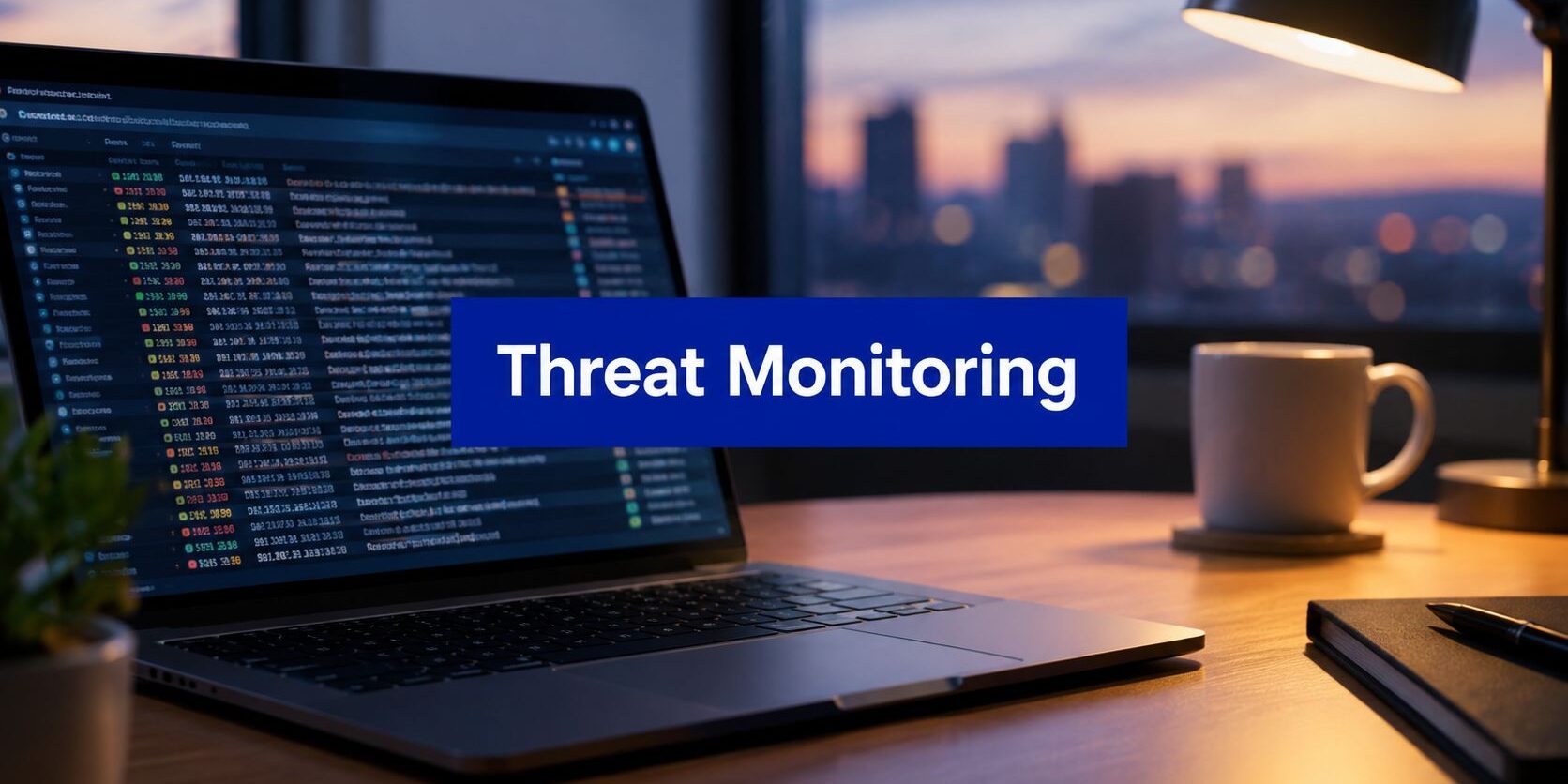
Cybersecurity threat monitoring is the continuous collection, correlation, and review of security signals from endpoints, networks, identities, cloud workloads, email, and external intelligence sources. The objective isn't to collect every possible event. It's to identify activity that suggests compromise, determine its business impact, and move quickly enough to limit damage.
A one-time vulnerability scan may find an exposed service. A penetration test may demonstrate how an attacker could reach a sensitive system. Neither one tells a business owner whether a stolen credential is being used tonight, whether an employee's mailbox has a forwarding rule, or whether a compromised laptop is communicating with an unusual external service.
Practical rule: A quiet network is only reassuring when someone is actively looking for quiet, credential-based activity.
Modern monitoring begins with telemetry. Endpoint agents record process launches, file changes, and other behavior. Identity systems provide login and access events. Firewalls and cloud services contribute connection and activity records. Analysts then correlate those signals, add context, and determine whether the pattern represents routine work, a policy violation, or an active attack.
That distinction matters for North Texas businesses with limited internal security staff. A clinic, law firm, construction company, or financial practice may have an IT generalist who can review an obvious malware alert, but not investigate every suspicious login, cloud permission change, or vendor account anomaly around the clock. A practical overview of service models and coverage can be found through Blowfish Technology security services.
The rest of the buying decision comes down to three questions: what data gets monitored, how alerts are prioritized, and who responds when the evidence points to compromise. The strongest service isn't the one promising the largest alert count. It's the one that delivers enough visibility and qualified triage to turn signals into decisions.
Core Technologies Behind Continuous Threat Monitoring
A monitoring stack works like a layered security team. Each layer sees a different part of the environment, and none should be treated as complete on its own. Businesses evaluating cybersecurity monitoring tools should ask what each layer detects, what it misses, and who reviews the output.
The collection layer
SIEM platforms ingest records from firewalls, identity providers, cloud applications, servers, and endpoints. Their strength is correlation. A single failed login means little, but a sequence involving unusual geography, access to a sensitive application, and a permission change deserves attention.
The blind spot is data quality. If a log source isn't connected, configured correctly, or retained long enough, the SIEM can't correlate what it never receives. A SIEM also won't replace human judgment. Rules can identify suspicious combinations, but an analyst still needs to understand the account, system, and business process involved.
The endpoint layer
EDR runs on laptops, servers, and supported workloads. It records process, file, and memory behavior, making it effective against suspicious scripts, unauthorized tools, persistence mechanisms, and other activity on a device.
Its limitation is scope. An endpoint agent may show what happened on a laptop, but not the full identity or cloud context behind the event. It can also generate excessive findings when detection rules aren't tuned to the organization's normal software and workflows.
XDR extends that endpoint story across identity, email, and network layers. It can connect a suspicious message, an account login, and endpoint behavior into one investigation. The trade-off is implementation complexity. Broader coverage only helps when the sources are integrated and the resulting detections are reviewed consistently.
The context layer
Threat intelligence adds outside information, such as known malicious domains, file hashes, IP addresses, and adversary techniques mapped to the MITRE ATT&CK framework. This context can raise the priority of an otherwise ambiguous event.
Threat intelligence isn't proof of compromise. Indicators can become outdated, shared infrastructure can create misleading matches, and an unfamiliar domain isn't automatically malicious. Analysts must combine intelligence with internal evidence before escalating.
The decision layer
A security operations center, whether internal or managed, performs the work that technology can't finish. Analysts validate alerts, investigate scope, contact designated stakeholders, contain affected systems, and document the outcome.
MITRE ATT&CK evaluations distinguish between telemetry, analytic coverage, visibility, and detection count. Telemetry confirms that a step occurred, while analytic coverage adds context about an attacker's intent or approach, which is why raw data alone isn't an actionable monitoring program (MITRE ATT&CK evaluation analysis). A useful explanation of the broader operating model is available in this guide to what is continuous monitoring.
How Continuous Monitoring Detects and Prioritizes Threats
Monitoring becomes useful through a repeatable loop, not through a dashboard filled with green status indicators. The loop starts by collecting signals, then normalizes them, enriches them with context, applies detection logic, and routes the result to triage.
Collect and normalize
The first task is coverage. Endpoint events, identity activity, cloud changes, network connections, and relevant external intelligence need consistent timestamps, user identifiers, asset names, and event categories. Normalization allows the monitoring service to compare activity that originated in different systems.
The volume can be substantial. Fortinet recorded 1.16 trillion scanning detections in 2024, up from 993 billion in the prior period, representing 16.71% year-over-year growth and approximately 36,000 scans per second (Fortinet's 2025 Global Threat Landscape Report). That activity illustrates why a business can't rely on someone casually reviewing isolated logs.
Enrich and detect
An alert becomes more useful when the monitoring team adds asset criticality, user risk, recent changes, known indicators, and attack technique context. A login anomaly involving a public training account shouldn't receive the same treatment as one involving a finance administrator.
Detection logic should combine rules with behavioral analysis. Rules catch known patterns, such as an unusual privilege change followed by suspicious access. Behavioral detections identify deviations from a user, device, or application baseline. Both approaches require tuning, because an alert with no operational context creates work without improving decisions.
Triage and respond
Priority should reflect impact and likelihood, not a raw severity label. Analysts need to determine whether the event involves a sensitive system, whether the behavior is continuing, whether credentials may be compromised, and whether other systems show related activity.
The framework used in independent ATT&CK evaluations combines detection and protection quality, including detection coverage, precision, and speed. It also measures false-positive performance and the time between technique execution and the first automated alert (MITRE Enterprise evaluation framework). That makes clear that a monitoring provider should discuss alert quality and response speed, not just the number of detections.
From raw signals to prioritized incidents
| Pipeline Stage | Daily Volume | Purpose |
|---|---|---|
| Raw signals | Environment-dependent | Capture activity from endpoints, identities, networks, and cloud services |
| Normalized events | Environment-dependent | Make records comparable and searchable |
| Detection candidates | Environment-dependent | Identify suspicious rules and behavioral patterns |
| Prioritized alerts | Environment-dependent | Add business and threat context |
| Confirmed incidents | Environment-dependent | Route validated compromise into response workflows |
The table intentionally avoids invented benchmarks. A vendor that supplies precise volume expectations without first reviewing the environment is selling a generic estimate, not an operating plan. Businesses evaluating response practices can also review this resource on London SMB threat response, then ask prospective providers to explain exactly how their own queue moves from event to incident.
The Hidden Failure Mode Most SMBs Miss
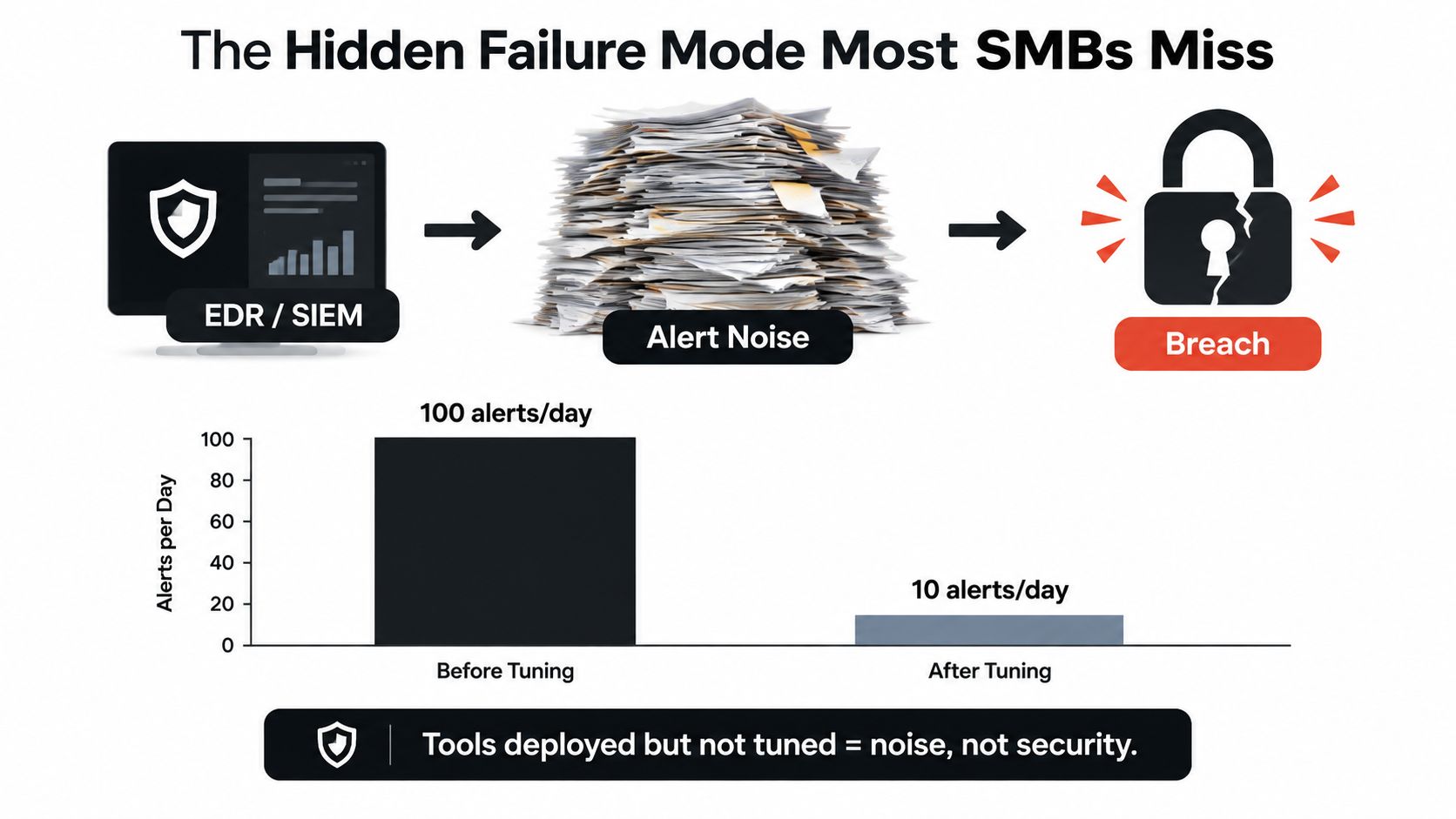
Most small and mid-sized businesses don't fail because they bought no security technology. They fail because the technology produces more work than the available staff can handle.
An EDR or SIEM gets deployed. Alerts start arriving. The lone IT generalist reviews the obvious items, postpones the ambiguous ones, and eventually treats the queue as background noise. An attacker doesn't need to defeat every control if the important alert remains buried among routine findings.
The alert-fatigue data is direct. 73% of organizations ranked false positives as their top detection challenge, 67% of security teams receive more than 2,000 alerts per day, and 92% reported incidents traced back to missed or uninvestigated alerts, according to the survey coverage summarized by Stamus Networks (alert fatigue and false-positive survey coverage).
Visibility doesn't mean coverage
A business can have a monitoring product and still lack visibility where attackers operate. Only 4% of organizations report full visibility across their security data estate, while 74% report cloud infrastructure blind spots and 67% lack visibility into identity and access behavior (Pulse of the AI SOC report).
That changes the buying question. Instead of asking how many alerts a provider can produce, an owner should ask which identity, cloud, endpoint, and lateral-movement signals the service can see, and who investigates them after normal business hours.
Better measure: Fewer, higher-context alerts routed to a qualified decision-maker are more valuable than a large queue nobody can clear.
IBM's breach research places the average time to identify a breach at about 194 days and the average time to contain it at 64 days (IBM breach timing summary). Those figures explain why triage is the hidden service differentiator. Monitoring earns its cost when it shortens the path from suspicious behavior to containment.
From Alert to Incident to Recovery The Response Workflow
A monitoring service should connect directly to an incident-response process. NIST's lifecycle includes preparation, detection and analysis, containment, eradication, recovery, and post-incident activity (NIST incident response lifecycle overview). For an SMB, that means every serious alert needs an owner, an escalation path, and a documented action.
The operating sequence
A high-confidence event might combine a SIEM correlation, EDR behavior, and an external intelligence match. The SOC analyst validates the user, device, time, and affected systems, then determines whether the event is isolated or part of a wider pattern.
Containment comes next. The team may isolate a host, disable or restrict an account, block a malicious connection, or pause a risky integration. The escalation package should state what happened, what evidence supports it, what has been contained, and what the client must approve.
Eradication removes persistence and addresses the root cause. That can include deleting unauthorized mechanisms, rotating credentials, correcting permissions, applying needed updates, and validating the environment with fresh checks. Recovery restores clean systems and resumes business operations while monitoring continues for re-entry.
Post-incident work turns the event into an improvement. The team produces a timeline, identifies missed signals, updates detection rules, and revises the response playbook. Without that feedback loop, the same alert may recur with the same confusion.
Three operating models
| Model | Staffing Required | Coverage | Indicative Annual Cost | Best Fit For |
|---|---|---|---|---|
| Fully in-house | Dedicated security analysts, incident leadership, and coverage planning | Controlled internally, with staffing limitations | Must be calculated from local staffing and technology requirements | Larger organizations with internal security operations |
| Co-managed | Existing IT team plus external analysts | Shared responsibility, with defined escalation boundaries | Depends on scope, tooling, and service hours | SMBs with capable IT staff needing specialist support |
| Fully managed SOC | Provider supplies analysts, monitoring operations, and playbooks | Continuous service based on contract scope | Depends on assets, coverage, retention, and response requirements | Businesses without round-the-clock security staffing |
A business owner should also review incident response procedures before signing a monitoring contract. If the provider can't explain who can authorize containment, the service may detect incidents without resolving them.
How Threat Monitoring Strengthens Compliance Programs
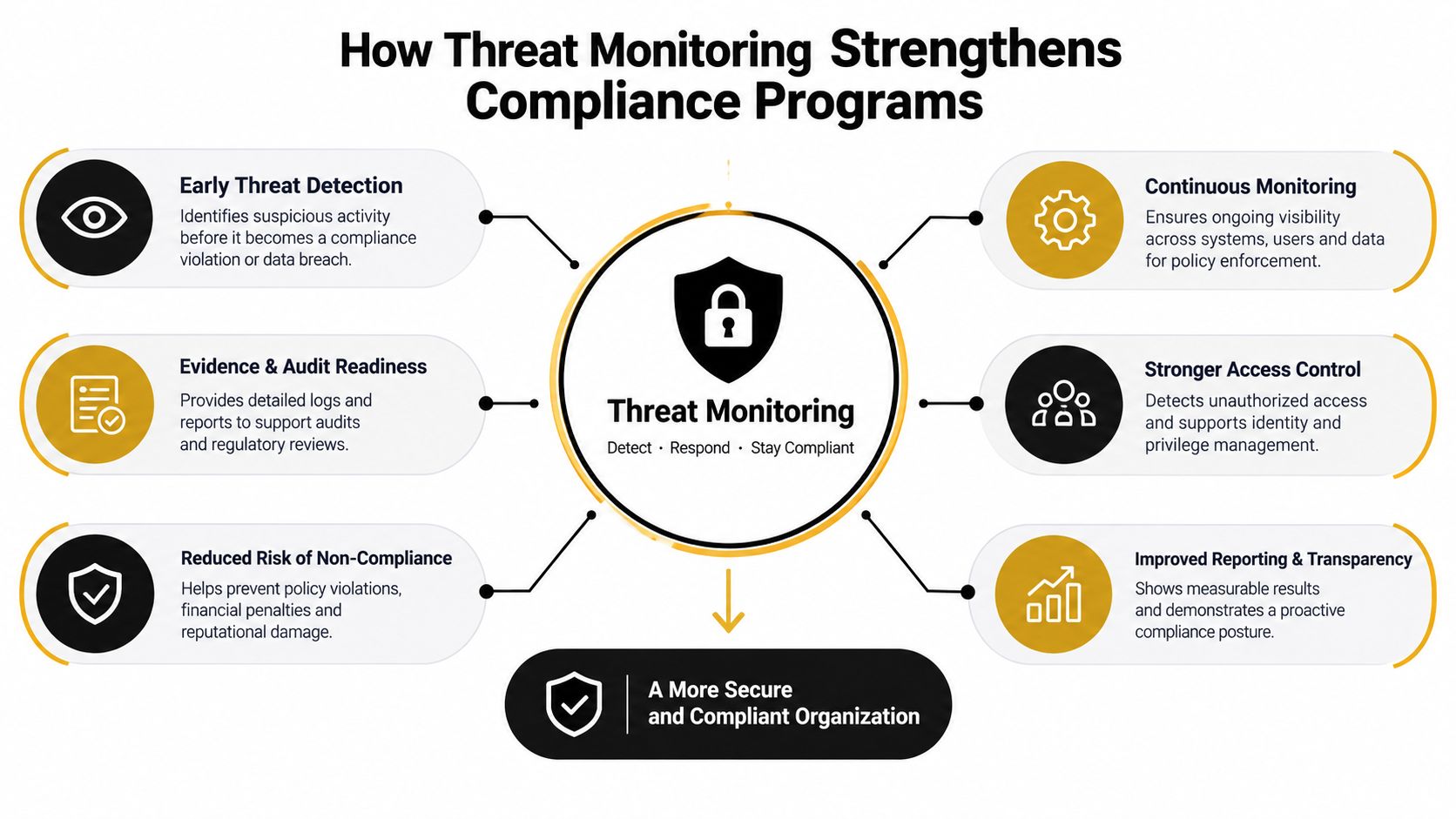
Compliance works better when monitoring produces evidence as part of normal operations. Instead of reconstructing activity before an audit, a disciplined program maintains access records, endpoint telemetry, change history, investigation notes, and response timestamps as events occur.
For healthcare practices, HIPAA Security Rule administrative safeguards connect naturally to documented incident handling, assigned responsibilities, and evidence that the organization can identify and address security events. For payment environments, PCI DSS Requirement 10 maps directly to logging and reviewing access and system activity. Organizations preparing for CMMC Level 2 can use an operating SOC to support event-monitoring and incident-response practice families.
Evidence should be automatic
A useful monitoring service should make it possible to retrieve:
- Access records: User logins, privilege changes, and unusual authentication activity.
- Endpoint evidence: Process activity, device status, file behavior, and containment actions.
- Change records: Administrative changes across systems, cloud services, and security controls.
- Response documentation: Alert timestamps, analyst decisions, escalation notes, and closure rationale.
CISA recommends logging and monitoring events, then prioritizing alerts with context such as source, destination, and event type rather than treating every signal equally (CISA logging and monitoring guidance). That approach supports both security operations and audit preparation.
Retention creates a practical trade-off. Monitoring data may need to be retained according to the applicable framework, often for 12 months or more, which affects storage, licensing, access controls, and tool selection. A provider should state what gets retained, for how long, and whether the client can export evidence.
Businesses can use a NIST compliance checklist to organize requirements, but regulated SMBs shouldn't rely on a checklist alone. A managed SOC can reduce the administrative burden by making audit-ready evidence the natural output of continuous operations.
A Practical 90-Day Implementation Roadmap
A monitoring rollout should produce proof of progress at every stage. The four phases below give a DFW business a practical sequence, while the exact scope depends on its users, systems, cloud services, regulatory obligations, and risk tolerance.
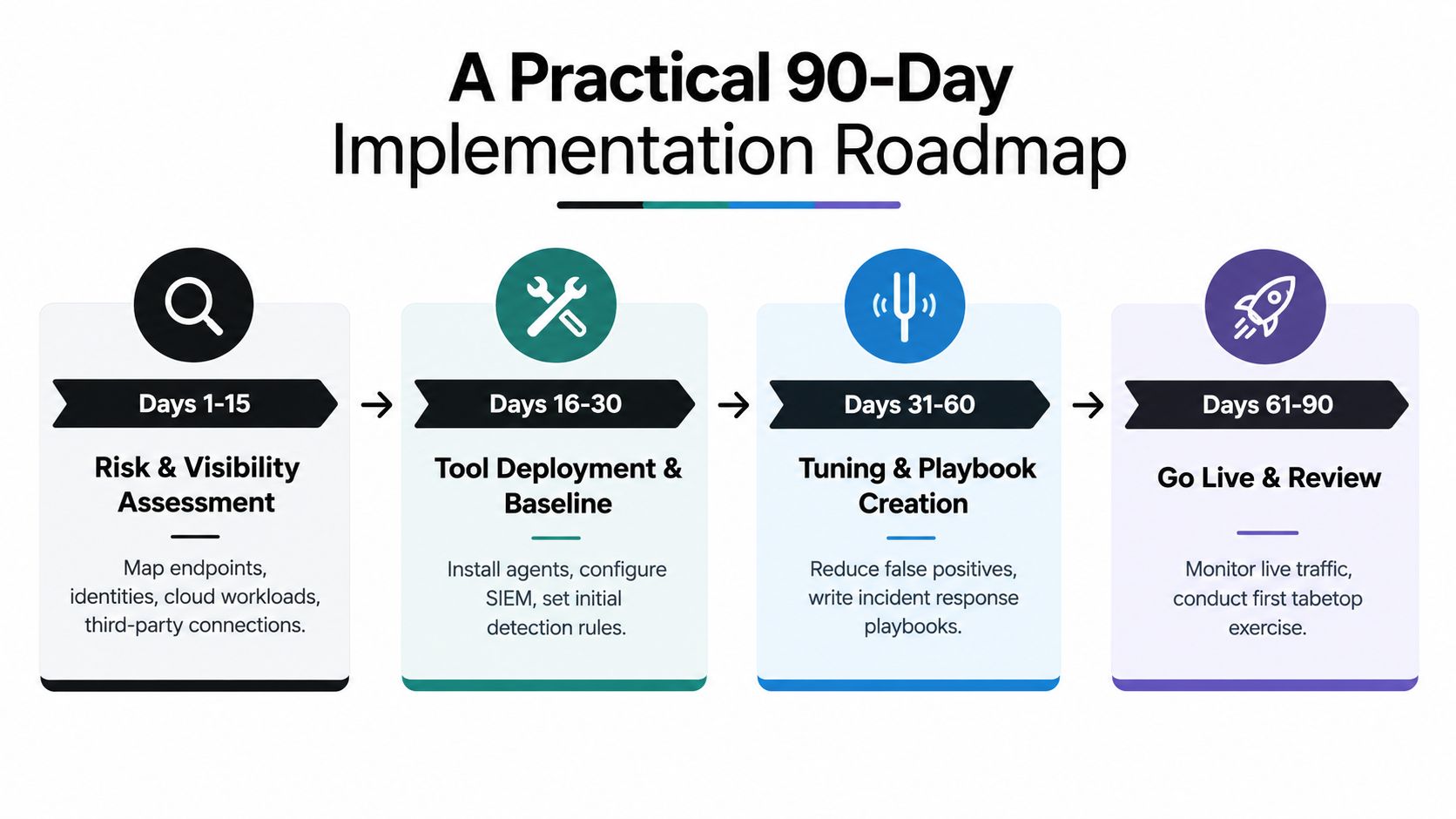
Phase one covers days 1 through 15
The owner, IT lead, and monitoring partner map endpoints, identities, cloud workloads, network controls, critical applications, and third-party connections. The deliverable is a visibility register showing what exists, what produces logs, and where meaningful gaps remain.
The exit criterion is an agreed coverage baseline. No deployment should begin until the business knows which systems matter most and which signals are currently unavailable.
Phase two covers days 16 through 45
The team deploys the selected SIEM or XDR capability, endpoint agents, identity monitoring, and relevant threat-intelligence feeds. Initial rules are configured, normal activity is baselined, and high-value assets receive priority.
The deliverable is a functioning collection and detection layer. The exit criterion is verified ingestion from the agreed sources, with test events reaching the monitoring queue and designated staff receiving notifications.
Phase three covers days 46 through 75
The provider and client formalize triage, escalation, containment authority, on-call responsibilities, and communications. They write playbooks for account compromise, suspicious endpoint behavior, cloud misconfiguration, and other scenarios relevant to the business.
Tabletop testing exposes unclear ownership before a real incident does. The exit criterion is a completed exercise with documented corrections and an approved escalation matrix.
Phase four covers days 76 through 90
The program moves into live review and measurement. High-severity detection should target MTTD under one hour, while MTTR trending below four hours can serve as an operating objective for suitable incidents, not a universal guarantee.
The measurement set should include:
- Mean time to detect: Compare current performance with the top 25% of organizations detecting incidents within 60 minutes, as reported in the SANS 2023 Incident Response Survey (SANS incident response timing summary).
- Mean time to respond or recover: Track elapsed time from validation through containment and service restoration.
- Alert-to-incident ratio: Determine whether the queue is producing useful investigations or mostly noise.
- False-positive rate: Identify rules that consume analyst time without improving protection.
- Patch latency: Record how long critical remediation takes after a validated exposure.
The final deliverable is a monthly operating report with trends, exceptions, open risks, and assigned actions. The exit criterion is management approval of the ongoing review cadence.
Choosing a Managed Monitoring Partner Worth Keeping
A monitoring provider should be evaluated on operational outcomes, not a polished portal. For a mid-sized business, the core checklist is straightforward:
- Real analyst coverage: A genuine 24/7 SOC with people reviewing and escalating events, not automation alone.
- Broad technology support: Native SIEM and EDR or XDR support across endpoints, identities, cloud services, and networks.
- Written performance commitments: Documented MTTD and MTTR service levels, with clear definitions and exclusions.
- Client access: Co-managed log access so the internal IT team can investigate without waiting for a vendor report.
- Transparent escalation: Specific rules for severity, notification, containment authority, and emergency contacts.
- Compliance evidence: Searchable evidence packages that support HIPAA, PCI DSS, and SOC 2 requirements where applicable.
- Outcome-based pricing: A commercial model that doesn't encourage unnecessary alerts or penalize the client for having useful telemetry.
Red flags deserve equal attention. A provider that hides behind a proprietary platform may make it difficult to transfer data or validate coverage. A vendor that quotes by alert volume can create the wrong incentive. A provider that can't identify the analysts handling escalations may not have the human operating model the contract implies.
Businesses comparing service approaches can use this guide to what is managed detection and response as a terminology reference. Technovation LLC, a Dallas–Fort Worth managed service provider, offers managed IT and cybersecurity services that include proactive monitoring, compliance support, risk mitigation, and response planning for North Texas organizations. The relevant buying test remains the same: confirm coverage, visibility, escalation, evidence, and measurable operating targets before choosing a provider.
Technovation LLC can assess a DFW business's endpoint, identity, cloud, and network visibility, then recommend a managed or co-managed cybersecurity threat monitoring model that fits its risk and staffing reality. Visit Technovation LLC to request a security audit or discuss 24/7 monitoring, incident response, and compliance-ready operations.